


Shadows in the Black Sea, Fire in the Sky: When Drones Become Precedents and Solar Storms Become Force Majeure - Romania defence law
- Amala Mararu

- Dec 5
- 9 min read
Aerospace & Tech Digest: Week 49 of 2025
“The Earth is the cradle of the mind, but one cannot remain in the cradle forever.”
- Konstantin Tsiolkovsky, 1911
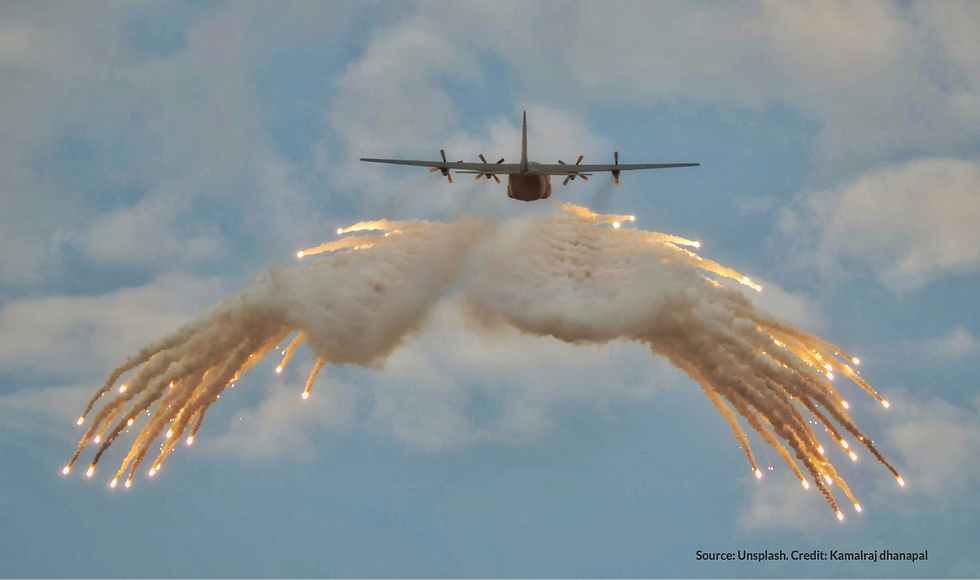
Yet the cradle is rocking violently this week, and the hand that rocks it wears the gloves of hybrid warfare, export-control clauses, and coronal-mass-ejection forecasts. While the Sun hurls plasma at us with the casual indifference, nation-states and corporations are writing the next chapter of jus in bello and jus ad astra in real time, often with the same pen.
Space Weather Snapshot - 4 December 2025, 18:07 UTC
NOAA SWPC reports an active Sun that has not quite calmed down after the X1.9 flare of 1 December from Region 4299. A G3 (Strong) geomagnetic storm warning remains in effect into the evening of 3 December, with a G2 (Moderate) watch extending into 4-5 December. Solar wind speeds are presently 647 km/s, Bz has been intermittently south at - 5 nT, and the planetary K-index has touched 5 several times in the last 24 hours. R1 (Minor) radio blackout conditions persist on the dayside.
Practical translation for operators: Starlink constellations are experiencing 2-4 % packet loss in polar routes; Iridium NEXT certainties have seen brief outages above 60° latitude; and at least three European MEO satellites executed unscheduled station-keeping burns yesterday to compensate for atmospheric drag that was 18 % higher than modelled. The ESCAPADE Mars twins (if New Glenn ever launches them) and the upcoming CSG-3 radar satellite will ride into a solar-wind regime that increases collision-risk delta-v budgets by approximately 12-15 m/s over nominal. Insurers are already drafting reservation-of-rights letters. Force majeure clauses in launch-service agreements are being read with the devotion normally reserved for sacred texts.
Romania and the Mistral Contract - Sovereignty Priced in Euros, Paid in Political Risk
On 27 November the Romanian Ministry of National Defence signed a government-to-government agreement with France for an initial batch of Mistral 3 very-short-range air-defence systems and later-generation Mistral ATLAS fire-control units valued in excess of €626 million. This is not merely procurement, it is a deliberate diversification move away from exclusive reliance on the American MIM-104 Patriot and a quiet but unmistakable signal to Washington that Bucharest will no longer accept being treated as a captive market. reuters.com
From a legal practitioner’s perspective the transaction is exquisite. Paris insists on MBDA retaining intellectual-property rights over the seeker software and the encrypted datalinks, while Bucharest demands local final assembly and future upgrade rights under Article 346 TFEU derogation. The resulting hybrid contract contains no fewer than five different governing laws (French for the missiles, Romanian for logistics, EU for offsets, NATO STANAGs for interoperability, and ITAR-lite clauses for the American components inside the ATLAS). I have seen cleaner arrangements in a 1997 Russian–Ukrainian helicopter co-production that ended in arbitration in Stockholm.
The theoretical foresight is more interesting than the price tag. Mistral 3 is man-portable, fire-and-forget, and possesses a documented kill probability against Group-1 and Group-2 drones of 0.94 in clutter-free conditions. When layered with the already-deployed Romanian Gepard, NASAMS, and Patriot batteries, Romania is creating the densest short-range air-defence bubble east of the Oder. The probabilistic outcome tree is now binary: either Moscow recalculates the cost of drone incursions into NATO airspace, or it escalates to stand-off cruise missiles, which triggers Article 5 and the precise scenario the Alliance has rehearsed since 2016. Bucharest has just moved the Overton window of acceptable deterrence thirty kilometres eastward.
The Black Sea Sea-Baby Incident - Romania Neutralises a Maritime Drone and Writes Customary Law in Real Time
On 3 December the Romanian Navy detected, tracked, and destroyed a surface drone approximately 35 nautical miles south-east of Sfântu Gheorghe in the Romanian exclusive economic zone. The drone carried no AIS, no flag, and approximately 300 kg of explosive. Bucharest described the action as “necessary to protect navigation and offshore infrastructure”. reuters.com
Let me speak plainly, this was the first kinetic engagement by a NATO member against a Russian (or Russian-proximate) unmanned surface vessel in the Black Sea since February 2022. The legal characterisation matters enormously. If the drone was in innocent passage (unlikely), Romania violated UNCLOS Article 19. If it posed an imminent threat, Article 51 preserves the inherent right of self-defence. The Romanian communiqué deliberately uses the phrase “endangering navigation” - the exact wording that triggers Montreux Convention parties recognise as justification for restrictive measures.
Watch what happens next, Moscow will almost certainly claim the drone was Ukrainian and demand compensation under the 1997 Friendship Treaty (still technically in force). Kyiv will remain silent. The incident will be folded into the next UN Security Council meeting as evidence of “Romanian aggression”. And somewhere in a quiet room in Brussels a young lawyer will add a new annex to NATO’s draft Rules of Engagement for unmanned systems. Precedents are being manufactured faster than 155 mm shells.
Suppose the drone had detonated against a Romanian-flagged LNG carrier under Cypriot charter with Romanian gas bound cargo. Who has standing to sue whom, under which flag, in which court, and for how much when the cargo insurer is Lloyd’s syndicate subscribing to war-risk exclusions drafted before anyone had heard of Sea Baby? The answer will cost someone nine figures and set the market rate for Black Sea war-risk premiums for the next decade.
Anduril’s Altius Crashes - When Venture-Capital Defence Meets Reality-Based Liability
Anduril, the darling of Silicon Valley disruption theology, suffered two separate crashes of its Altius-600M loitering munition during U.S. Army testing in November. The Air Force’s summary (leaked with the enthusiasm normally reserved for cryptocurrency white papers) cites software reversion logic failure and uncommanded control-surface deflection. reuters.com
The contractual implications are deliciously brutal. The Army’s OTA (Other Transaction Authority) agreement contains milestone payments tied to “successful flight demonstration”. Two crashes equal zero payment. More importantly, FAR 52.246-2 inspection clauses and DFARS 252.246-7000 warranty clauses now collide with Anduril’s commercial-style “as-is” mentality”. Someone is going to discover that “move fast and break things” is expensive when the things cost $1.8 million each and the breakage occurs over American soil.
From a theoretical point of view the United States is subsidising the creation of a generation of autonomous systems whose liability regime remains essentially pre-industrial. When (not if) an Altius variant kills civilians in a future conflict, the chain of accountability runs through a Cayman GP, a Delaware LLC, a DoD program office, and a lattice of insurance policies that explicitly exclude “algorithmic error”. We are one software update away from the first billion-dollar products-liability case in which no earthly court will have jurisdiction to hear.
Leonardo’s “Michelangelo Dome” - Europe Finally Admits It Needs a Shield and Names It After a Renaissance Painter
Leonardo S.p.A. unveiled on 4 December the “Michelangelo Dome” concept: a sovereign European integrated air and missile defence architecture built around common command-and-control, shared radars, and effectors from MBDA, Diehl, and (crucially) Israeli data-fusion algorithms. flightplan.forecastinternational.com
The irony is almost painful. Europe spent thirty years telling the United States that missile defence was destabilising, then watched Iran fire 180 ballistic missiles at Israel in October 2024 and Russia fire Kinzhals at Kyiv daily, and suddenly discovers that shields are rather useful after all. The proposed funding mechanism is the European Defence Fund plus national contributions plus (whisper it) a new EU defence bond that Germany still pretends does not exist.
Romania, already operating Patriot, NASAMS, and now Mistral, is geographically indispensable to any southern-tier architecture. Bucharest has the political will, the terrain, and the recent memory of drone fragments landing in the Danube Delta. If the Dome ever becomes reality, the first operational sector will almost certainly be the Black Sea corridor from Constanţa to Odesa. The legal question that keeps me awake: who possesses the firing key when a threat is detected over international waters but trajectory predicts impact in two NATO states and one non-NATO state? The answer will be written in classified annexes that our grandchildren will still be arguing over.
Raytheon-Amazon Web Services Strategic Collaboration - The Cloud Literally Above the Battlefield
Raytheon announced on 4 December a deepened partnership with Amazon Web Services to migrate classified space-domain-awareness workloads to commercial cloud regions. This mean that the U.S. Space Force wants to run orbital conjunction warnings on servers that also host Netflix recommendation algorithms. morningstar.com
The legal tension is exquisite. GDPR adequacy decisions do not apply above 100 km altitude. CMMC 2.0 Level 3 certification is required for ground segments, yet the data will transit through commercial fibre that Brussels considers American jurisdiction. Somewhere in the fine print is a clause that says “in the event of conflicting national security directives, U.S. law prevails”. European allies are being asked to trust a clause that explicitly says not to trust it.
Sci-fi becomes balance sheet when the next Carrington-level event arrives (probability ≈ 8–12 % per decade according to 2024 Lloyd’s modelling), the satellites that survive will be those whose orbits were adjusted using AWS-hosted predictive analytics. The ones that do not survive will generate claims under Article VII of the Outer Space Treaty against whichever state was “launching state”. Good luck serving process on a cloud region.
The F-35 Engine Sustainment Contract - $1.6 Billion Reasons to Keep the Fleet Flying and the Lawyers Employed
Pratt & Whitney received a $1.6 billion modification on 28 November for F135 sustainment through 2028. Romania, having signed for 32 F-35A (plus 16 option) in 2023, is now locked into the same engine supply chain that cannot meet current demand. The legal risk is no longer whether the aircraft will arrive, it is whether the engines will be available when they do. Expect a quiet Romanian diplomatic note requesting priority allocation under the moment the first airframe touches down at Câmpia Turzii. airandspacesforces.com
If I will write a model of “Black Sea Drone Engagement Clause” I would insert it into the next NATO-Romania defence cooperation agreement. The clause must satisfy (1) Article 51 UN Charter proportionality, (2) Chicago Convention Annex 2 rules over the high seas, (3) Romanian constitutional requirements for parliamentary approval of hostilities, and (4) the political necessity of not looking weak to Moscow.
This Week in STEM-in-Aerospace History
Date | Event |
29 November 1961 | Enos the chimpanzee completes two orbits aboard Mercury-Atlas 5, proving humans can survive orbital flight and returning with nothing more than a bruised ego and a desire for bananas. |
1 December 1971 | Soviet Mars 3 achieves the first soft-landing on Mars; the first human artefact to touch the Martian surface transmits 20 seconds of grey static before dying – a metaphor for many space-law careers.[70] |
2 December 1971 | Soviet Mars 3 lander operates for 14.5 seconds on the surface (still the record for shortest successful Mars transmission until Perseverance). |
3 December 1973 | Pioneer 10 makes closest approach to Jupiter, returning the first close-up images and surviving radiation that would sterilise a human in minutes. |
4 December 1965 | Gemini 7 launches, setting the stage for Frank Borman and Jim Lovell’s fourteen-day endurance flight – still the longest duration two humans have spent together in a phone booth. |
4 December 1998 | STS-88 launches the Unity node, the first American module of the International Space Station, beginning the largest international law experiment in history. |
30 November 2018 | InSight lands on Mars and immediately begins listening for marsquakes with a French seismometer paid for, in part, by German taxes - the most European thing ever done off planet. |
Upcoming 45-Day Horizon (World / Central Europe / South-East Europe Focus)
NET 15-20 December 2025 - Falcon 9, Starlink Group 12-x from Vandenberg (Romanian ground stations at Constanța will track).
5 January 2026 - Falcon 9, Pandora (NASA/CLPS) and others from Vandenberg – possible Romanian participation via ESA’s SST programme.
NET January 2026 - Possible New Glenn inaugural flight (ESCAPADE Mars) - watch for ITAR fights over photonics payloads.
Q1 2026 - Expected first Romanian Air Force F-35 pilot conversion training in the United States.
The cradle has been kicked over. Humanity now crawls across the floor toward the launch pad, clutching treaties in one hand and liability waivers in the other, while the Universe looks on with the amused indifference of a physicist who already knows the final examination answers.
Gravity does not recognise sovereign immunity. Vacuum respects no flag. Solar protons laugh at export-control classifications, and orbital mechanics has never once stayed its hand because a Security Council resolution asked nicely.
We draft clauses for Mars, yet still argue about whose drone fell in the Danube Delta. We write force majeure for coronal mass ejections while quietly praying the next one arrives after the quarterly earnings call. We dream of multi-planetary salvation, but the road there is paved with Black Sea drone fragments, French missile software licences, and the stubborn refusal of great powers to read the fine print.
The stars remain magnificently uninterested in our progress. They simply wait to see which of our beautifully crafted legal fictions survive re-entry intact, and which burn up as brightly and briefly as a failing Altius over the Arizona desert.
See you in Week 50, when the Sun may finally quiet down, but the borders, the balance sheets, and the kill chains almost certainly will not.
Until then, keep your visor down and your precedents current.
CC BY-NC-SA 4.0 © 2025 Amala Mararu. All rights reserved.


Comments